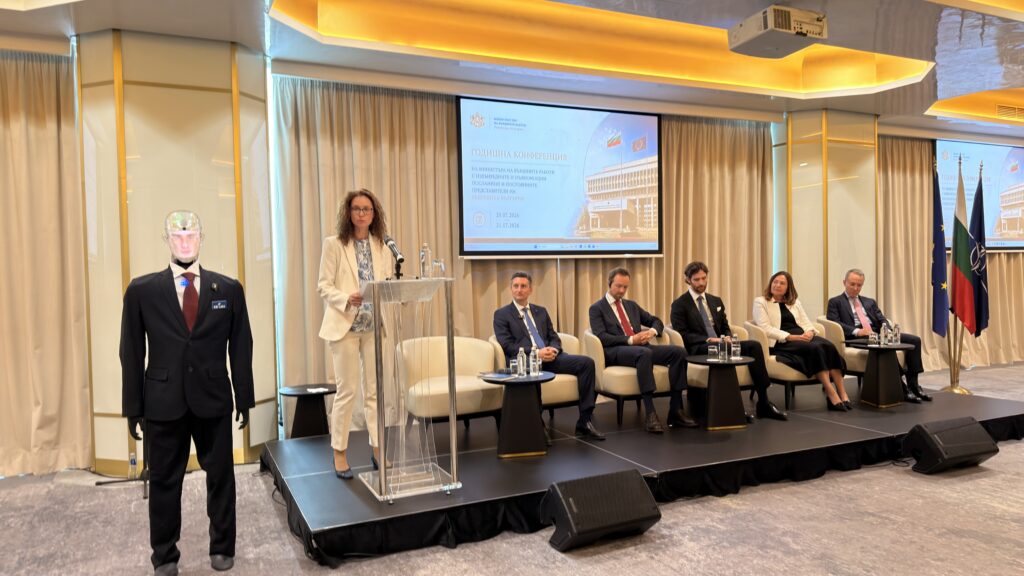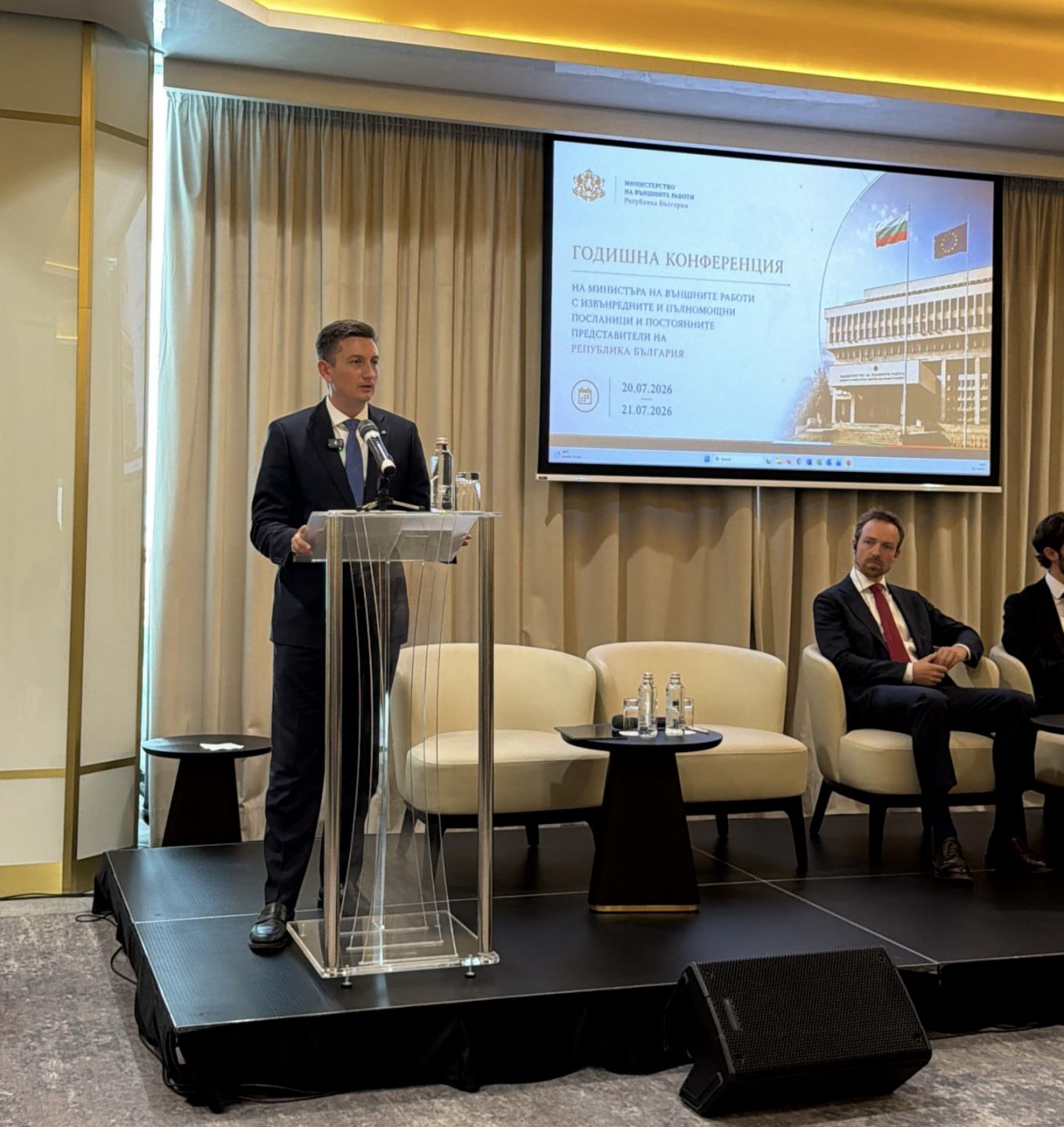
Bulgaria has not only the ambition but also the potential to become a leading voice in the debate on the future of technology. When discussing other issues, we have often approached the international community somewhat hesitantly, knowing that we rank near the bottom of certain rankings. This is not the case when it comes to technology, entrepreneurship, innovation and talent. In these areas, Bulgaria has a solid foundation and now also has a government that acts as an accelerator of innovation and a partner to the high-tech sector. We want to position our country ever more prominently on the map of the technological revolution. This was stated by Minister of Innovation and Digital Transformation Ivan Vasilev at the annual conference bringing together Bulgaria’s ambassadors extraordinary and plenipotentiary and its permanent representatives, organised by the Ministry of Foreign Affairs. He took part in the panel on artificial intelligence, innovation and digital diplomacy.
Addressing the diplomats, Vasilev highlighted two of the ambitious goals: the transformation of Bulgaria’s economic model towards one based on industries that generate high added value, and the digital transformation of the services provided by the state to citizens and businesses.
“I have set myself the goal of making Bulgaria the best place in Europe to start and grow a business that creates high added value by 2030. We have all the necessary conditions: talent, access to capital and a government that will put the necessary legal framework in place,” he explained. He stressed that all the other ministers also have an important and active role to play in identifying the processes that will lead to faster administrative services for citizens and the business community.
Vasilev said that the Ministry of Innovation and Digital Transformation was integrating artificial intelligence into its day-to-day operations and encouraged other institutions to do the same. He also informed the ambassadors that he had established a “Council of Robots”. “I believe that technology is not an enemy, but a means of achieving more with less. They will not replace us, they have no right to vote, no right to sign documents and no right to make decisions, but they do have the right to take part in the discussion. The future will be dominated by technology, but it will be built by people,” the Minister of Innovation stated.
He urged the ambassadors to take an active part in this dialogue. “Bulgaria has something to offer. It can not only follow but also lead, because we have the potential,” Vasilev added. He also noted that, at the most recent Telecommunications Council meeting in Luxembourg, the European Commission had called on Member States to develop more open-source software, and ministers had discussed how to do so in their respective countries. “I took the floor and said that we were already doing this in Bulgaria. In its very first month, the Ministry publicly released Sigma, its system for oversight and transparency in public spending, and made its source code available to everyone – not only so that they could view it, but also so that they could build on it,” he explained in his address at the conference.
In response to a question from the ambassadors about the need for closer cooperation between Bulgaria and the European Space Agency, Vasilev said that talks were under way and that Bulgaria’s ambition was to become an Associate Member of ESA as soon as possible. He added that a series of steps was also being taken to establish the Dobroslavtsi business zone as a hub for space technology.
“The International Olympiad in Artificial Intelligence was established in Bulgaria. The International Olympiad in Informatics was established in Bulgaria as well. Bulgarian participants hold positions in the top three and top four of the all-time rankings of the international Olympiads in mathematics, informatics, physics, chemistry and computational linguistics. Thirty-two years ago, we were among the top four football teams in the world. Today, we rank eighty-first. Let us make sure that, thirty-two years from now, we do not rank eighty-first in mathematics, informatics or computational linguistics. We have inherited a legacy that makes us proud, but also obliges us to keep progressing,” the minister added.
Vasilev summed up by saying that Bulgaria had everything it needed to become the leading force in global technological transformation, and expressed the hope that this message would be communicated through Bulgarian diplomats serving in countries around the world. “The Ministry of Innovation and Digital Transformation and I will provide each and every one of you with whatever information you need to tell our country’s story and present its potential. Bulgaria must begin to show confidence, establish its positions and defend them with dignity,” the minister concluded in his address to the ambassadors.