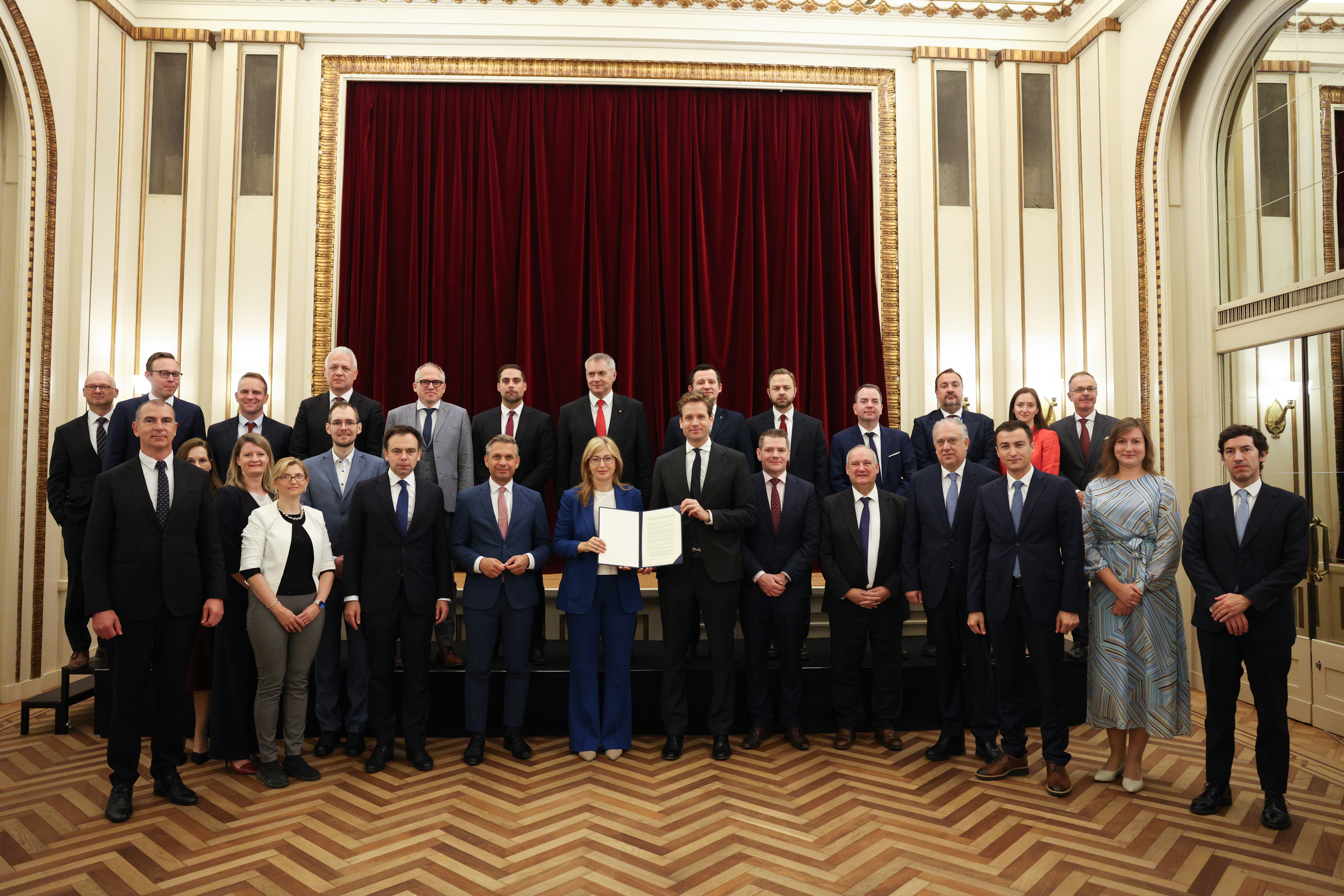
The document reflects Europe’s unity and its strategic vision for leadership in the semiconductor sector.
Bulgaria has signed a Declaration of Cooperation in the field of the semiconductor industry (Semicon Declaration). In Brussels, Deputy Minister for Innovation and Growth, Prof. Georgi Angelov, attended the formal submission of the document to the European Commission. The Declaration seeks to reinforce EU policy on semiconductors, with a particular focus on the upcoming revision of the European Chips Act (Chips Act 2.0). The declaration is endorsed by all 27 EU Member States.
Through the declaration, Member States form a semiconductor coalition expressing their intention to safeguard supply chains in the semiconductor industry, develop innovative technologies across the entire value chain, support start-ups and scale-ups, and ensure close coordination in this key European industry.
The declaration calls on the European Commission to pursue three key objectives when updating the European Chips Act:
- Prosperity: reinforcing Europe’s semiconductor ecosystem to generate economic and societal value;
- Indispensability: sustaining and strengthening leadership at key points throughout the value chain;
- Resilience: ensuring operational capacity, supply chain stability, and technological autonomy; End markets such as artificial intelligence, the automotive industry, energy, and defence should play a central role in further shaping these objectives; of facilitations In addition, the Declaration sets out five policy priorities:
- Ecosystem: strengthening cooperation between industry, research, SMEs and start-ups;
- Investments: aligning EU and national funding; accelerating the approval of strategic projects and mobilising private capital;
- Skills: building a strong European talent base in semiconductor technologies;
- Sustainability: promoting environmentally friendly, energy-efficient and circular semiconductor production;
- International partnerships: cooperating with like-minded global partners while preserving Europe’s strategic autonomy;

“Semiconductors are of critical importance. We are committed to implementing the updated European Chips Act (EU Chips Act 2.0) to ensure prosperity, strategic autonomy, and resilience,” Deputy Minister Prof. Angelov said.
He noted that Bulgaria is striving for a knowledge-based, high value-added economy. To that end, the country builds on national and European priorities set out in the relevant strategic documents, with a focus on semiconductor chips, space and defence.
“Our understanding is that chips are the foundation of high value-added sectors. Bulgaria aims to strengthen its existing participation in the supply chain and add value in the semiconductor industry, and to expand its involvement by acquiring and developing new capabilities,” Prof. Angelov said.
He added that Bulgaria’s vision focuses on developing chip design and creating intellectual property (IP), establishing backend manufacturing operations, including the assembly, testing and packaging of fabricated chips, and producing equipment used in chip manufacturing. The plans also include strengthening research, education and training, and integrating artificial intelligence, building on Bulgaria’s established and recognised position in information technology.
“We are convinced that Europe’s efforts to achieve a leading position in the global semiconductor industry are critically important and, at the same time, realistic. When it comes to strengthening supply-chain resilience in Europe, it is worth considering the possibilities for financial mechanisms and incentives to build production capacity, especially in countries that do not have such facilities,” the Deputy Minister said.
“The semiconductor coalition lays the foundations for a new type of European cooperation, cooperation built on Europe’s achievements (technological, scientific and political) and aligned with current and forthcoming challenges,” Prof. Angelov concluded.